Media Buying vs Media Production: Where Should You Invest Your Budget?
Executive Summary
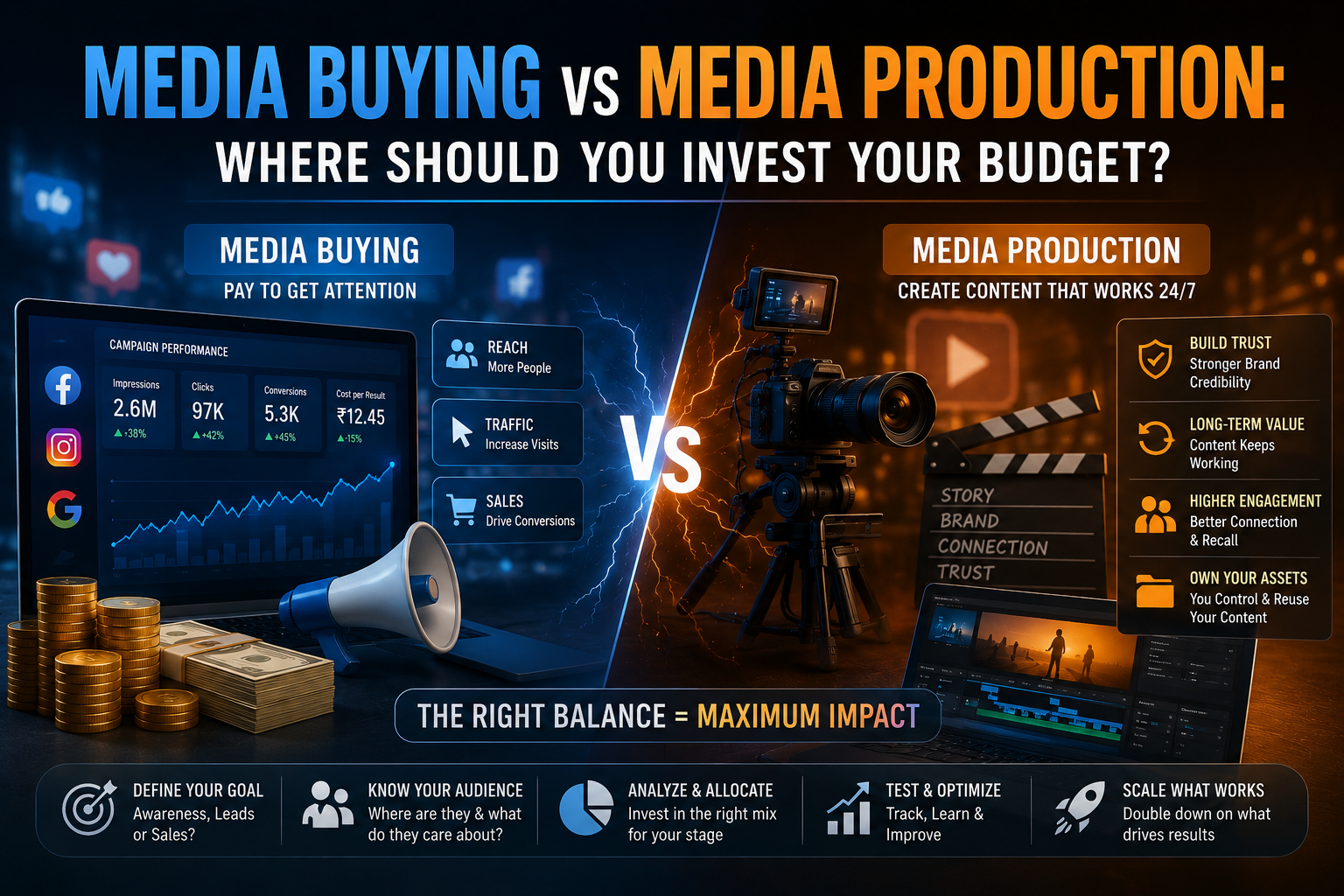
Business owners often use the terms "media buying" and "media production" interchangeably when discussing their marketing budgets. This is a fatal financial error. Media buying is the act of paying algorithms (Google, Meta) to distribute your message. Media production is the act of creating the message itself (the video, the podcast, the photography).
If you spend all your money on distribution but your creative is terrible, your ads will fail. If you spend all your money on a cinematic video but have no budget to distribute it, no one will see it. This guide provides a mathematical framework for balancing your investment between creation and distribution to ensure maximum Return on Investment (ROI).
Quick Answer
- Media Production (The Asset): The creation of high-fidelity content (corporate films, podcasts, graphic design). It builds trust, elevates brand equity, and permanently lowers your customer acquisition costs over time.
- Media Buying (The Distribution): The strategic purchase of ad space (Google Ads, Meta Ads, YouTube Pre-roll). It generates immediate traffic and transactions but offers no long-term equity once you stop paying.
- The Ideal Balance: The most successful brands employ a hybrid model, investing heavily in premium media production and using calculated media buying to force that premium media into the feeds of their exact target demographic.
For a comprehensive breakdown of the organizations that handle these disciplines, read our foundational guide: Media Company vs Digital Marketing Agency: Which Is the Better Choice?
Business Context: The Distribution Trap
Over the last decade, Digital Marketing Agencies convinced business owners that algorithms were magic. The prevailing advice was to spend 95% of your marketing budget on media buying (paying Facebook or Google) and 5% on cheap, offshore graphic design.
For a brief period in 2017, this worked. Ad costs were low, and any business could buy cheap clicks.
Today, that strategy guarantees bankruptcy. The algorithms have matured. Meta and Google now heavily penalize low-quality, generic advertisements by charging them a higher Cost Per Click (CPC). In contrast, high-retention, high-fidelity videos are rewarded with incredibly cheap distribution.
If your ad account is failing, the problem is rarely the "media buying strategy." The problem is the "media production." Your creative is not good enough to hold attention.
The Decision Framework: The Budget Allocation Matrix™
How should a scaling business divide its capital between production and distribution? At NimNit, we use the Budget Allocation Matrix™ to guide our clients.
1. The Startup Phase (The 20/80 Rule)
- 20% Production / 80% Distribution
- If you are a startup with limited capital, you cannot afford a Hollywood-level commercial. You need raw, authentic, user-generated-style content shot on an iPhone, and you must pump the vast majority of your budget into media buying to test the market and generate immediate cash flow.
2. The Scaling Phase (The 40/60 Rule)
- 40% Production / 60% Distribution
- Once you have proven product-market fit, you must upgrade your brand perception. You allocate 40% of your budget to a media company for professional Video Production and high-quality assets. The remaining 60% is used to distribute these premium assets, ensuring you capture market share from cheaper-looking competitors.
3. The Authority Phase (The 60/40 Rule)
- 60% Production / 40% Distribution
- For enterprise B2B brands, premium healthcare clinics, and established luxury brands, trust is the only currency. You invest heavily in massive "Anchor Assets" (like a branded Podcast or an original documentary series). Because these assets are so compelling, they generate massive organic (free) distribution, allowing you to reduce your paid media buying budget over time.
Common Mistakes in Budget Allocation
When navigating the intersection of production and buying, avoid these common errors:
- The "Empty Theater" Syndrome: Spending ₹5,000,000 on a stunning corporate brand film, but having zero budget left to run YouTube or LinkedIn ads to show it to your target audience. You built a beautiful theater, but you couldn't afford to print tickets.
- The "Broken Megaphone" Syndrome: Spending ₹10,00,000 a month on Meta ads, but forcing the media buyer to use terrible stock photos because you refused to pay for a professional photo shoot. You bought the biggest megaphone in the world, but you have nothing interesting to say into it.
- Confusing Media Buyers with Creatives: Assuming that the person pulling the levers inside the Google Ads dashboard also knows how to write a compelling script, direct a camera crew, and color-grade footage. These are entirely different skill sets.
Implementation Advice: The Hybrid Engine
To fix this divide, your business must adopt a hybrid engine. This means your Media Production team and your Media Buying team must operate in total alignment.
When you partner with NimNit, you do not have to choose. We operate as a full-suite Media Company. We write the script, shoot the cinematic video, and edit the micro-content. Then, our in-house performance marketing team manages the media buying, deploying those assets across Google and Meta.
This creates a continuous feedback loop:
- The Media Buyers test three different video variations.
- They realize Variation B has a 40% higher click-through rate.
- They instantly notify the Media Production team.
- The Production team edits five new videos mimicking the style of Variation B.
This seamless integration drastically lowers your Cost Per Acquisition. (Read more about how this loop functions on Our Process page).
Frequently Asked Questions
Which is more important: good targeting or good creative?
In the modern digital landscape, the creative is the targeting. Machine learning algorithms on TikTok and Instagram are so advanced that if you produce a highly engaging video about commercial real estate, the algorithm will automatically find commercial real estate investors to show it to, regardless of your manual targeting settings.
Can SEO replace media buying?
SEO (Search Engine Optimization) is a form of organic media distribution. It is highly effective and generates the highest quality leads, but it takes 6 to 12 months to mature. Media buying generates traffic today. A healthy business uses media buying for short-term revenue and SEO for long-term stability.
Does podcasting count as media production or media buying?
Producing the podcast (the studio, the cameras, the editing) is Media Production. Paying Spotify or LinkedIn to run ads promoting that podcast is Media Buying.
The Bottom Line
You cannot win with just distribution, and you cannot win with just creation. You need a partner who understands the mathematics of media buying and the artistry of media production.
Book a Discovery Call with NimNit to Build Your Hybrid Engine
Related Reading
About NimNit Media & Production
NimNit is a premium media production and digital marketing company based in Jaipur, Rajasthan. We specialize in conceptualizing cinematic video storylines, producing broadcast-quality podcasts, and managing high-retention social media marketing campaigns that drive authentic business growth. Under the strategic direction of RJ Chhavi, our team of directors, cinematographers, and audio engineers helps brands transition from traditional marketing to brand-owned media.
Whether you require cinematic corporate films, product video shoots, sound design, voice-overs, or local SEO campaigns in Jaipur, we deliver commercial-grade production with complete intellectual property ownership. Explore our comprehensive media services or contact our Jaipur studio to schedule a brand strategy consultation.
Frequently Asked Questions
What services does NimNit offer in Jaipur?
We offer end-to-end media services including corporate video production, commercial video editing, professional podcast hosting and recording, voice-over services in Hindi and English, and performance-based social media management.
How does NimNit optimize video campaigns for ROI?
Unlike standard videographers, we integrate marketing psychology and retention algorithms into our shoots. We repurpose flagship films into multi-platform short-form assets to maximize your content distribution budget.