SEO vs Google Ads: Where Should You Invest First?
Executive Summary
The most common question fielded by our strategy team is: "Should I spend my budget on SEO or Google Ads?"
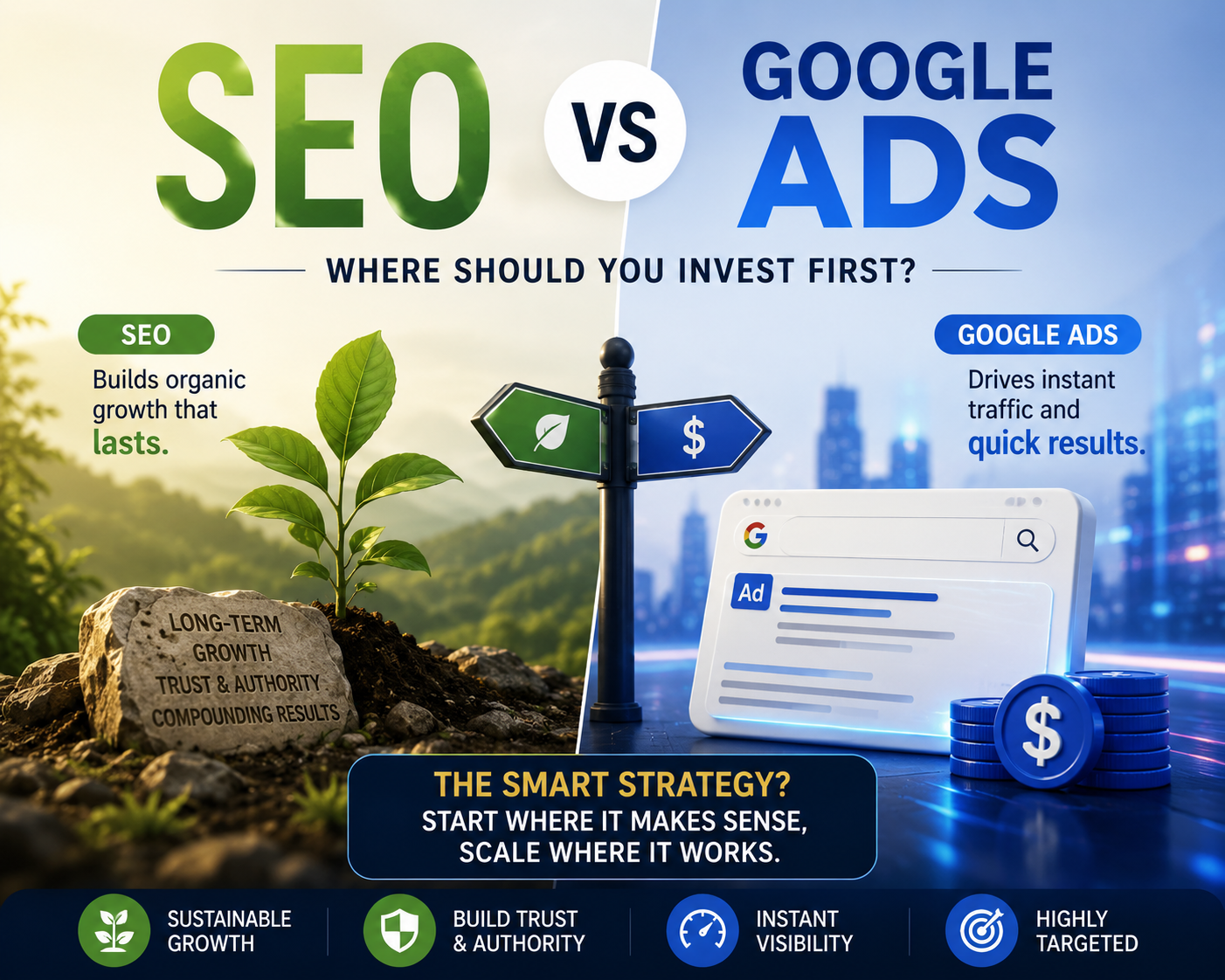
The answer is rarely "one or the other." Choosing between SEO (Search Engine Optimization) and Google Ads (PPC) is not a marketing decision; it is a cash-flow decision. Google Ads is a high-speed, high-cost engine designed for immediate revenue generation, but it builds zero long-term equity. SEO is an architectural investment that requires 6 to 12 months to mature, but ultimately delivers the lowest Cost Per Acquisition (CPA) in digital marketing. This commercial investigation guide deconstructs the financial realities of both channels and introduces the Marketing Investment Pyramid™ to help you deploy capital with mathematical precision.
Quick Answer
- Choose Google Ads if: You need leads this week to make payroll, you are launching a brand new service, or you are testing market viability. (Fast execution, high cost, zero equity).
- Choose SEO if: Your cash flow is stable, you want to build a "digital moat" against competitors, and you are playing a multi-year growth game. (Slow execution, low long-term cost, massive equity).
- The Ideal Scenario: Run Google Ads to capture immediate cash flow, while simultaneously building your SEO architecture in the background. Once the SEO matures, you can taper off your ad spend.
For a comprehensive overview of how these channels fit into a broader ecosystem, read our definitive pillar: The Complete Guide to Digital Marketing for Businesses in Jaipur.
Business Context: The Two Types of Real Estate
To understand the difference between SEO and Google Ads, you must understand digital real estate.
When a user searches for "Best Commercial Architect in Jaipur," the Google Search Engine Results Page (SERP) is divided into two distinct zones.
- The Rented Property (Google Ads): These are the sponsored links at the very top of the page. You "rent" this space by bidding against your competitors in a live auction. Every time someone clicks your link, you pay Google (Cost Per Click). The moment your credit card declines, your listing vanishes.
- The Owned Property (SEO): These are the organic listings below the ads and the Local Map Pack. You cannot buy this space. You must "earn" it by proving to Google's algorithm that your website is the most authoritative, technically sound, and relevant answer to the user's query. Once you own this space, clicks are completely free.
Business owners often make the mistake of viewing these as competing strategies. In reality, they serve entirely different financial functions.
When to Choose Google Ads (PPC)
Google Ads is the ultimate direct-response mechanism. You are capturing users at the exact moment of "High Intent."
The Strengths
- Speed to Market: A skilled Digital Marketing Company can launch a Google Ads campaign in 48 hours. By day three, your phone could be ringing.
- Granular Control: You can dictate exactly what keywords trigger your ads. If you are a high-end dentist, you can bid on "dental implants cost" but block your ad from showing for "cheap dentist near me."
- A/B Testing: You can test two different landing pages simultaneously to see which one converts visitors into leads at a higher percentage.
The Limitations
- The "Ad Tax": The cost of Google Ads rises every year as more competitors enter the auction. This continuously squeezes your profit margins.
- Ad Blindness: A significant portion of internet users (up to 30%) use ad blockers or subconsciously scroll past anything marked "Sponsored" because they trust organic results more.
- Zero Asset Value: If you spend ₹10,00,000 on Google Ads over a year, you generate revenue, but you build no permanent asset. The day you stop spending, your traffic drops to zero.
When to Choose SEO (Search Engine Optimization)
SEO is the process of building digital infrastructure. It involves Technical SEO (website code), On-Page SEO (semantic content), and Off-Page SEO (acquiring backlinks).
The Strengths
- The Ultimate ROI: Once a page ranks #1 organically for a high-volume keyword, it will generate thousands of clicks for free. Over a three-year period, the Cost Per Acquisition (CPA) of an SEO lead is a fraction of a Google Ads lead.
- Higher Trust: Users implicitly trust organic results. Being ranked #1 by Google acts as a massive third-party endorsement of your brand's authority.
- Compound Interest: Like a financial portfolio, SEO compounds. An authoritative article published today can continue to generate traffic and leads five years from now.
The Limitations
- The Time Horizon: SEO is incredibly slow. Google does not trust new websites. It takes a minimum of 4 to 8 months of aggressive, sustained effort by an SEO Agency to see significant ranking improvements for competitive terms.
- Algorithmic Volatility: Google updates its algorithm thousands of times a year. A core update can occasionally penalize a website, requiring technical intervention to recover traffic.
- High Initial Investment: Building the architecture requires upfront capital (copywriters, technical audits, web development) before any leads are generated.
The Decision Framework: The Marketing Investment Pyramid™
At NimNit, we deploy capital using the Marketing Investment Pyramid™. This framework dictates how budget is allocated across the two channels based on the business's maturity.
Level 1: The Survival Phase (Months 1-3)
- Allocation: 80% Google Ads / 20% SEO
- Objective: Cash Flow. You need leads immediately. We pour the vast majority of the budget into targeted Google Ads to generate immediate revenue. The remaining 20% is used to fix critical technical SEO errors on the website so the foundation is solid.
Level 2: The Scaling Phase (Months 4-9)
- Allocation: 50% Google Ads / 50% SEO
- Objective: Transition. The Google Ads are running profitably. We take the profits from those ads and aggressively reinvest them into a heavy SEO strategy (publishing semantic hubs, acquiring backlinks, and producing high-end Content).
Level 3: The Authority Phase (Months 10+)
- Allocation: 20% Google Ads / 80% SEO
- Objective: Dominance. The SEO architecture has matured. You now rank organically for your most profitable keywords. Your traffic is "free." We reduce the Google Ads budget to only capture niche, hyper-specific queries, while the bulk of the business is driven by the massive organic moat you have built.
Common Mistakes in Search Marketing
- Turning SEO Off and On: SEO is not a faucet. If you pause your SEO efforts for three months, your competitors will overtake you, and regaining that position will take twice as long.
- Bidding on Vanity Keywords: A B2B software company bidding on the broad keyword "software" instead of the highly specific "enterprise inventory software for logistics." Broad keywords drain ad budgets instantly.
- Sending Paid Traffic to a Bad Landing Page: Paying ₹100 for a click and sending the user to a slow, confusing homepage. You must send paid traffic to dedicated, conversion-optimized landing pages featuring premium Video Production to maximize trust.
Implementation Advice: The Synergistic Approach
The most sophisticated businesses do not view SEO and Google Ads as an either/or proposition. They use them synergistically.
- Use Google Ads for R&D: Launch a Google Ad campaign targeting 50 different keywords. After 30 days, review the data. You will discover that 3 specific keywords generated 80% of your revenue.
- Deploy SEO for Profitability: Now that you have mathematically proven which 3 keywords are the most profitable, instruct your SEO team to build a 3,000-word pillar article and semantic cluster entirely focused on dominating those exact keywords organically.
You use the speed of paid ads to discover the truth, and you use the depth of SEO to own it permanently.
Frequently Asked Questions
If I rank #1 organically, should I still run Google Ads?
Yes, for "Brand Defense." If you rank #1 organically for your brand name, your competitors can still bid on your name and appear above you in the sponsored section. Running a low-budget brand campaign ensures you occupy both the #1 Ad spot and the #1 Organic spot, dominating the screen.
Can a single agency handle both?
Yes, provided they have distinct, specialized teams. Managing a live Google Ads auction requires a vastly different mathematical skill set than writing semantic SEO content. Ensure your partner has dedicated specialists for both disciplines.
Which channel is better for a brand new website?
Google Ads. A brand new domain exists in the "Google Sandbox" and will struggle to rank organically for competitive terms for several months. Google Ads bridges that gap.
Build Your Search Architecture
Whether you need the immediate cash flow of a precision-targeted Google Ads campaign or the long-term dominance of an Enterprise SEO architecture, we build the systems that generate predictable revenue.
Book a Strategic Search Consultation with NimNit
Related Reading
About NimNit Media & Production
NimNit is a premium media production and digital marketing company based in Jaipur, Rajasthan. We specialize in conceptualizing cinematic video storylines, producing broadcast-quality podcasts, and managing high-retention social media marketing campaigns that drive authentic business growth. Under the strategic direction of RJ Chhavi, our team of directors, cinematographers, and audio engineers helps brands transition from traditional marketing to brand-owned media.
Whether you require cinematic corporate films, product video shoots, sound design, voice-overs, or local SEO campaigns in Jaipur, we deliver commercial-grade production with complete intellectual property ownership. Explore our comprehensive media services or contact our Jaipur studio to schedule a brand strategy consultation.
Frequently Asked Questions
What services does NimNit offer in Jaipur?
We offer end-to-end media services including corporate video production, commercial video editing, professional podcast hosting and recording, voice-over services in Hindi and English, and performance-based social media management.
How does NimNit optimize video campaigns for ROI?
Unlike standard videographers, we integrate marketing psychology and retention algorithms into our shoots. We repurpose flagship films into multi-platform short-form assets to maximize your content distribution budget.