What Should a Small Business Spend on Digital Marketing?
Executive Summary
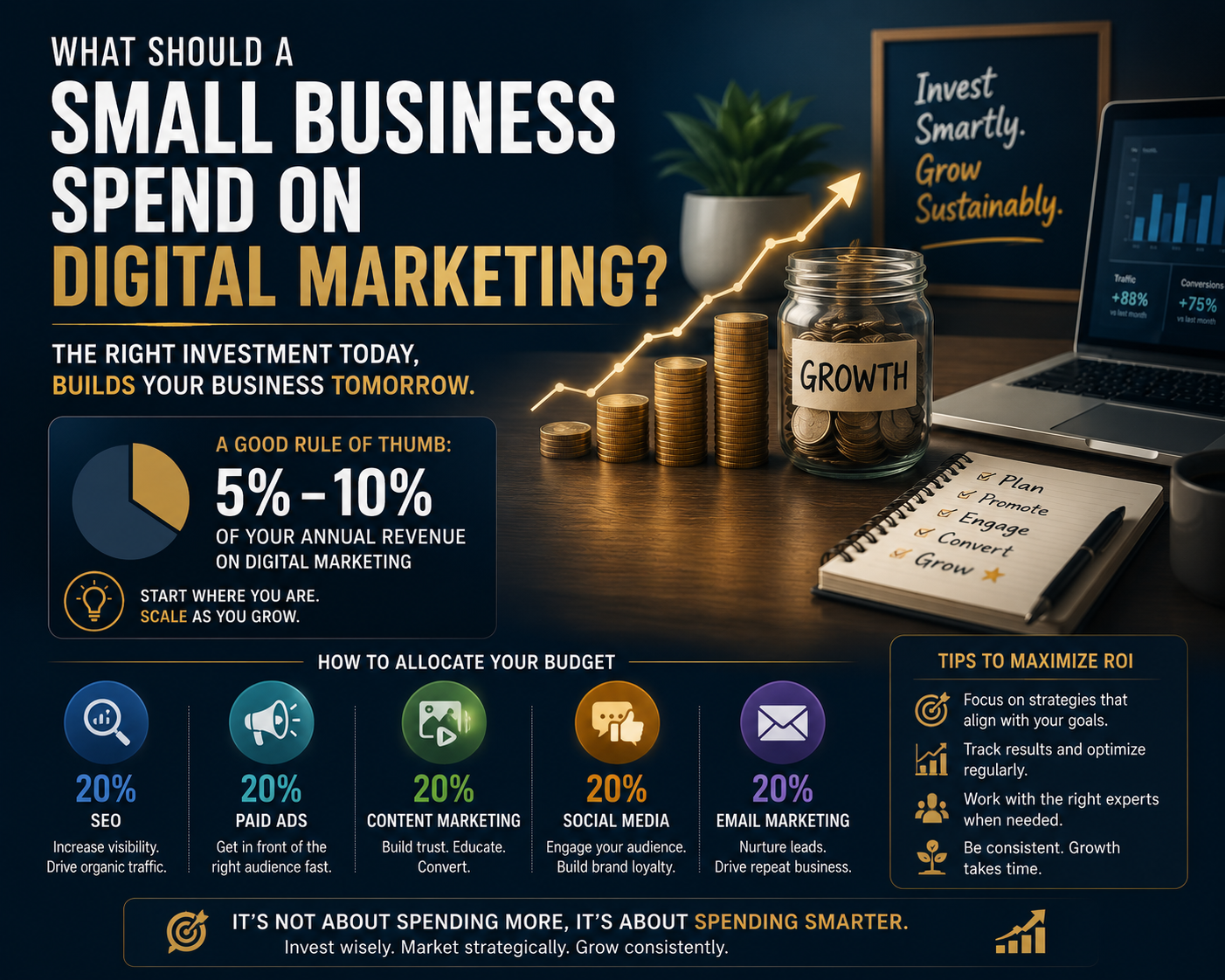
One of the most persistent questions in the agency world is, "How much should I spend on digital marketing?" Unfortunately, most business owners approach this question backwards. They look at what cash is leftover at the end of the month and declare that to be the marketing budget. This treats marketing as an operational expense rather than a revenue-generating asset. This guide provides a set of strict financial principles to help small and medium businesses calculate their digital marketing budget based on their growth objectives, profit margins, and maximum allowable Cost Per Acquisition (CPA).
Quick Answer
There is no universal flat fee for marketing, but there are mathematical rules:
- Maintenance Mode: If you just want to maintain current revenue, spend 5% to 8% of gross revenue.
- Growth Mode: If you want to capture market share and scale aggressively, spend 10% to 15% of gross revenue.
- The True Rule: If you can mathematically prove that every ₹1 you put into marketing generates ₹4 in gross profit, your budget should be infinite until you hit operational capacity.
For a comprehensive view of how to deploy this budget across different channels, read our definitive pillar: The Complete Guide to Digital Marketing for Businesses in Jaipur.
Business Context: The "Cheap Agency" Illusion
Many small businesses in Jaipur attempt to solve the budget question by simply finding the cheapest possible Digital Marketing Company. They find a freelancer or a generic agency willing to "run their social media" for ₹15,000 a month.
This is a dangerous illusion.
If you spend ₹15,000 a month and generate ₹0 in new revenue, that is an infinitely bad investment. Conversely, if you spend ₹1,50,000 a month on a premium strategy that includes broadcast-quality Corporate Video and aggressive Google Ads, and it generates ₹10,00,000 in new revenue, the marketing effectively cost you nothing.
You must decouple your mind from the "monthly retainer fee" and focus exclusively on Return on Ad Spend (ROAS).
The Decision Framework: Budgeting Principles
Do not guess your budget. Use these three core financial principles to calculate it.
Principle 1: The Percentage Rule
The U.S. Small Business Administration (SBA) and leading financial analysts recommend a percentage-based approach based on gross revenue:
- B2B Companies: Generally spend between 5% and 10%. Their sales cycles are longer and rely more on relationship-building (e.g., LinkedIn Ads, Podcasts, and Semantic SEO).
- B2C Companies: Generally spend between 10% and 15%. Retail, hospitality, and e-commerce rely heavily on high-volume, visual advertising (Meta Ads, Influencer Marketing) to constantly drive consumer traffic.
Example: If a Jaipur-based boutique hotel generates ₹1 Crore in annual revenue and wants to grow, they should expect to deploy ₹10 Lakh to ₹15 Lakh annually on a comprehensive digital ecosystem.
Principle 2: The CPA Ceiling (Cost Per Acquisition)
A percentage of revenue is a good starting point, but the CPA Ceiling is how you manage daily operations.
You must know your numbers:
- What is the Lifetime Value (LTV) of your customer?
- What is your Gross Profit Margin on that LTV?
- What is the maximum amount you can spend to acquire that customer and still remain profitable?
Example: If a dental clinic makes a profit of ₹20,000 on an implant procedure, they might determine their CPA Ceiling is ₹5,000. If their marketing agency can acquire a patient via Google Ads for ₹3,000, the clinic is highly profitable. If the cost rises to ₹6,000, the campaign must be paused and restructured.
Principle 3: The 60/40 Production Split
A common error is allocating 100% of the budget to media buying (paying Google/Facebook). If you do this, your creative assets will be terrible, and your ads will fail.
You must split your budget between creation and distribution:
- 40% for Media Production: This is the cost of the Content Creation, the video shoots, the graphic design, and the copywriting.
- 60% for Media Buying: This is the cash paid directly to the ad platforms to distribute those assets.
(Note: In the very early days of a startup, this ratio might be 20/80, but it must equalize as you build a premium brand).
Common Budgeting Mistakes
- The "Wait and See" Budget: Giving an agency ₹10,000 to "test" Google Ads for two weeks. This is mathematically guaranteed to fail. The platform algorithms require sufficient budget and time (usually 30-45 days) to exit the "learning phase." If you cannot afford to fund the learning phase, do not run ads.
- Ignoring the Website Foundation: Spending 90% of your budget on aggressive social media ads while sending that traffic to a website built in 2015 that takes 8 seconds to load. You must invest budget into your SEO Services and website infrastructure first.
- Failing to Track: Spending money without installing the Meta Pixel or Google Analytics 4. If you cannot track the origin of a sale, you cannot optimize the budget.
Implementation Advice: The Phased Rollout
If you have a set annual budget, do not spend it evenly across 12 months. Marketing requires heavy initial lifting.
- Month 1-2 (The Build): Heavy capital expenditure. You are paying for technical SEO audits, website overhauls, and flagship video production. Ad spend is low.
- Month 3-6 (The Scale): Operational expenditure. The assets are built. The vast majority of the budget now shifts to aggressive Media Buying and ongoing micro-content distribution to capture market share.
- Month 7+ (The Optimization): Maintenance expenditure. You are analyzing the data, cutting the bottom 20% of underperforming ads, and scaling the top 20% of winning campaigns.
Frequently Asked Questions
Can I do digital marketing for free?
Yes, you can post organically on social media and attempt to write your own SEO articles. This costs no cash, but it costs hundreds of hours of your time. For a business owner, time is usually more expensive than cash.
Why do some agencies charge a flat fee while others charge a percentage of ad spend?
A flat retainer usually covers the strategic management and content creation. Agencies charge a percentage of ad spend (usually 10-20%) because managing a ₹1,00,000 ad account requires significantly less labor and risk management than managing a ₹50,00,000 ad account.
Should I take out a loan for marketing?
Only if you have mathematical proof of your CPA. If you have been running campaigns for 6 months and have proven that every ₹1 you spend yields ₹3, utilizing leverage (debt) to scale that campaign is a standard business practice. Do not use debt to "experiment."
Build a Predictable Revenue Engine
Stop guessing your marketing budget. Treat it as a mathematical equation. If you need a partner to help you calculate your CPA and build an architecture that actually converts, it's time to upgrade your infrastructure.
Book a Strategic Financial Marketing Audit with NimNit
Related Reading
About NimNit Media & Production
NimNit is a premium media production and digital marketing company based in Jaipur, Rajasthan. We specialize in conceptualizing cinematic video storylines, producing broadcast-quality podcasts, and managing high-retention social media marketing campaigns that drive authentic business growth. Under the strategic direction of RJ Chhavi, our team of directors, cinematographers, and audio engineers helps brands transition from traditional marketing to brand-owned media.
Whether you require cinematic corporate films, product video shoots, sound design, voice-overs, or local SEO campaigns in Jaipur, we deliver commercial-grade production with complete intellectual property ownership. Explore our comprehensive media services or contact our Jaipur studio to schedule a brand strategy consultation.
Frequently Asked Questions
What services does NimNit offer in Jaipur?
We offer end-to-end media services including corporate video production, commercial video editing, professional podcast hosting and recording, voice-over services in Hindi and English, and performance-based social media management.
How does NimNit optimize video campaigns for ROI?
Unlike standard videographers, we integrate marketing psychology and retention algorithms into our shoots. We repurpose flagship films into multi-platform short-form assets to maximize your content distribution budget.